How to Prepare for a Notary Public Appointment
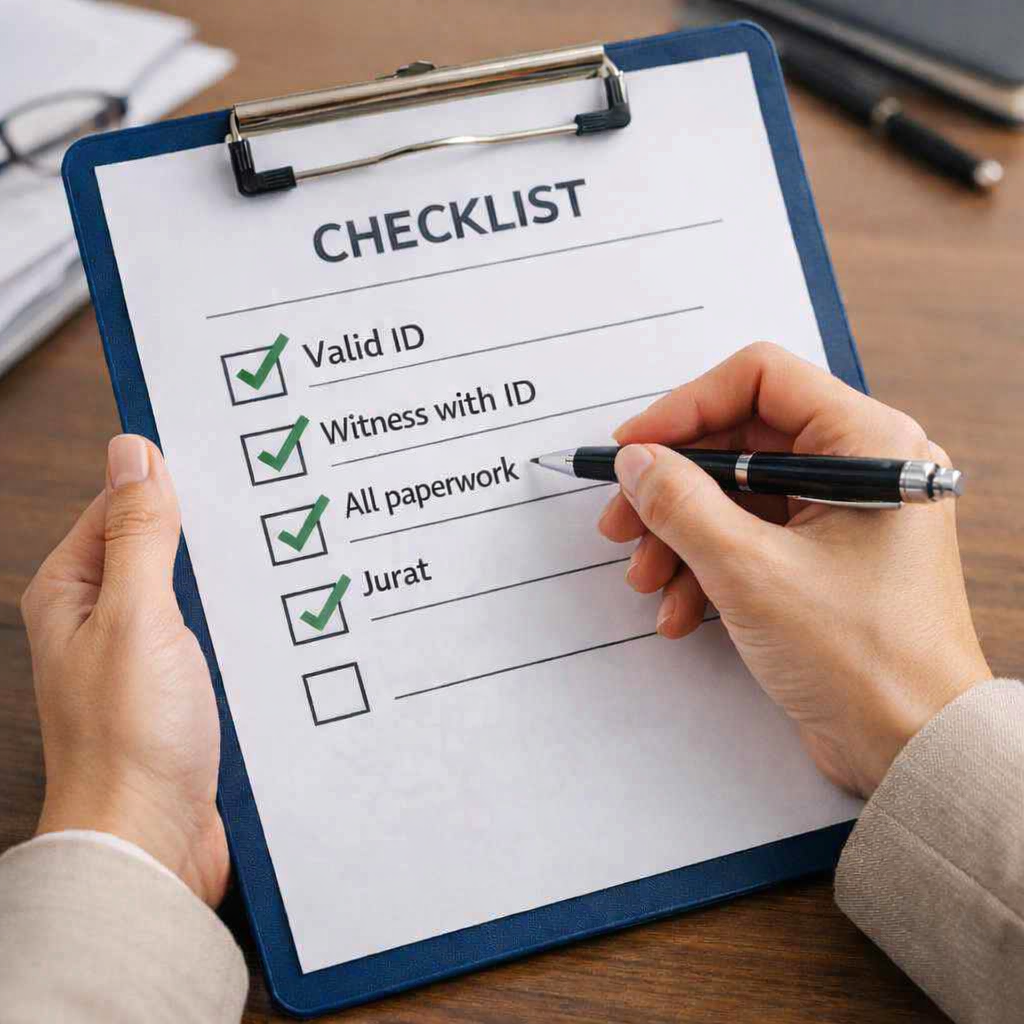
1. Valid Government-Issued Photo ID
Bring a valid, government-issued photo ID. This is the single most important requirement. The notary must verify your identity before notarizing anything.
Accepted forms of ID typically include:
- Driver’s license or state ID
- U.S. passport or passport card
- Military ID
- Permanent resident card (Green Card)
⚠️ Expired IDs are generally not accepted. Make sure yours is current.
2. Unsigned Document
Do NOT sign the document beforehand. This is the most common mistake people make. The whole point of a notary is to witness you signing in person. If you’ve already signed, the notary may refuse the document and you may need a new one.
3. No Missing Pages, Blanks, or White-out
Bring the complete, unsigned document
- All pages must be present — no missing pages, blanks in critical fields, or white-out
- The document should be fully filled out except for the signature line
- Some documents require witness signatures in addition to notarization — know this ahead of time and bring your witnesses with you
4. Know What Type of Notarization
Know what type of notarization is needed documents usually specify this, but the three most common are:
- Acknowledgment — you confirm the signature is yours and you signed willingly
- Jurat — you swear or affirm the contents are true (requires an oath)
- Copy Certification — the notary verifies a copy matches the original
If you’re unsure, ask the attorney or agency that gave you the document.
5. All Signers Must be Present
Bring all required signers every person who needs to sign must be physically present with their own valid ID. A notary cannot notarize a signature for someone who isn’t there.
6. Do You Need a Witness
Bring required witnesses (If applicable). Some documents, like wills and powers of attorney in Texas, require one or two witnesses in addition to the notary. The witnesses typically cannot be:
- A beneficiary of the document
- A relative of the signer
- The notary themselves
Check your document’s requirements in advance.
7. Be prepared to pay. Notary fees in Texas are set by state law at a maximum of $10.00 for the first signature and $1.00 for each additional signature (for standard notarizations). Mobile notaries may charge a travel fee on top of this. Ask about pricing when you book.
8. A Notary Public Cannot
Understand what a notary public cannot do. A notary public is not a lawyer. They cannot:
- Tell you if a document is legally valid
- Advise you on what to sign
- Prepare legal documents for you
- Notarize a document in a language they don’t understand
If you have legal questions about the document itself, consult an attorney before your appointment.
9. Last But Not Least
For mobile notary appointments
- Have a flat, well-lit surface ready to sign on
- Have your ID easily accessible
- Make sure all signers and witnesses are present at the agreed location
- Confirm the appointment time and address in advance
Appointment Checklist
| Items | People |
| ✅ Valid, unexpired government photo ID | ✅ All required signers present with their own ID |
| ✅ Document(s) UNSIGNED | ✅ Witnesses present (if required) |
| ✅ Know what type of notarization is needed | ✅ Payment ready |